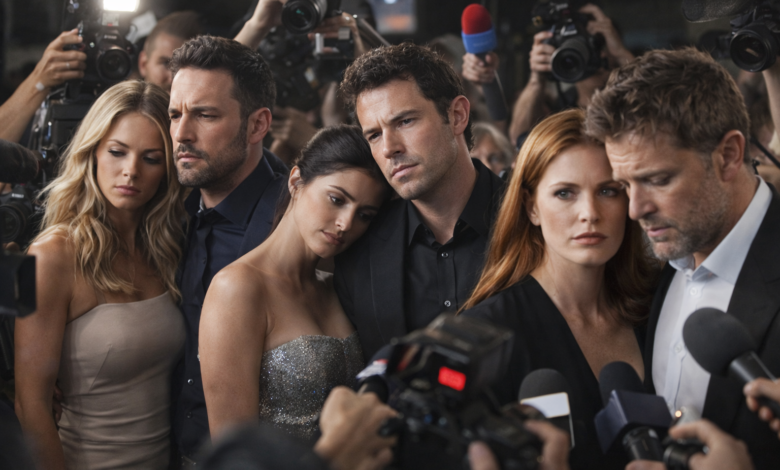
Most people learn about love in private. They fumble through it in kitchens and parked cars and badly lit apartments, and nobody writes a headline about the outcome. Celebrities do not get that. Their relationships begin under observation, proceed under observation, and collapse under observation, and the fact that so many of those relationships do collapse has less to do with bad luck than with a very specific set of pressures that almost no one else has to manage. The money, the schedules, the competing ambitions, the millions of strangers who feel entitled to an opinion about your marriage. All of it stacks against longevity. The numbers confirm what the tabloids suggest, and the reasons behind those numbers are worth looking at with some care.
Table of Contents
The Numbers Tell a Consistent Story
According to the Marriage Foundation, celebrities as a group divorce at roughly double the rate of ordinary people. Within the first year of marriage, they are almost 6 times more likely to divorce than non-celebrities. Over a 10-year window, celebrity divorce rates sit around 40%, compared to approximately 20% in the UK and 30% in the US. These are not small margins.
Divorce lawyer Vanessa Lloyd-Platt has studied the pattern closely and found that celebrity marriages tend to be 75% shorter than the national average. She attributes much of this to what she calls “Competing Ego Syndrome,” a dynamic where one partner’s rising fame generates jealousy and frustration in the other. That term may sound clinical, but the phenomenon is easy to recognize in practice. When 2 people in a relationship are both public figures, and one of them starts getting more attention, the imbalance puts real strain on the partnership.
Why Fame Itself Creates Instability
Celebrity life involves long stretches of separation. Film shoots last month. Tours run across continents. Press cycles demand constant availability. Maintaining a relationship under those conditions requires a level of coordination and tolerance that would test anyone, and it tests people whose egos are constantly being inflated by professional success.


There is also the question of access. Celebrities are surrounded by people who want something from them, and that includes romantic attention. Temptation is not an abstract concept when you are regularly told you are the most attractive person in a room. Combine that with frequent travel, limited accountability, and a social circle full of other attractive, successful people, and fidelity becomes a matter of active discipline rather than passive habit.
Then there is the public itself. Fans develop parasocial attachments to celebrities and their partners, forming emotional investments in relationships they have no actual part in. When those relationships face difficulty, fans react with personal disappointment or anger, adding external pressure to what should be private decisions.
Volatile Relationship Decisions
Celebrities often pursue arrangements that sit well outside conventional dating. Open marriages, age-gap pairings, sugar daddy relationships, and other non-traditional setups are increasingly visible among public figures. Will and Jada Pinkett Smith have spoken openly about their own terms for partnership, and actor Nico Tortorella has done the same.
A 2023 Pew Research Center study found that about 51% of adults under 30 consider open marriages acceptable. That number suggests the public is catching up to what many celebrities have practiced for years, even if the tabloid reaction remains predictable.
Recent Breakups That Fit the Pattern
The past couple of years have offered plenty of examples. Nicole Kidman filed for divorce from Keith Urban after 18 years of marriage. Kelsea Ballerini and Chase Stokes broke up again in early 2026, having previously attempted to make things work. Ali Wong and Bill Hader split after 2 years together.
Each of these cases involves different circumstances, but they share common features. Busy careers pulling people in different directions. Public scrutiny that makes private resolution harder. The simple fact that fame changes a person over time, and 2 people who were compatible at the start of a relationship may not stay that way.
Money Complicates Everything
Wealth removes certain relationship problems and introduces others. Financial stress is one of the most common reasons ordinary couples fight, and celebrities generally do not have that concern. But wealth creates its own complications. Prenuptial agreements, property disputes, business entanglements, and the involvement of managers, agents, and lawyers in personal decisions all add friction.
When a celebrity couple separates, the financial unwinding is often public, contentious, and slow. That prospect alone can keep people in relationships longer than they should stay, or push them out faster than they might otherwise leave, depending on how the finances are structured.
The Audience Factor
People consume celebrity relationships as content. Magazines, social media accounts, and gossip sites treat partnerships as stories with arcs and conclusions. The audience roots for certain couples and turns on others. That kind of attention has a corrosive effect, because it turns something personal into something performed.
Couples who know they are being watched tend to behave differently than those who do not. Some perform closeness they do not feel. Others hide problems until they become unmanageable. Neither response is healthy, and both are predictable outcomes of living under constant public attention.
So Why Does Any of It Surprise Us?
The honest answer is that it probably should not. Celebrity relationships operate under conditions that would strain any partnership, and the fact that many of them fail is a predictable outcome rather than a mystery. The real question is why anyone expects otherwise, and the answer to that lies more in how we consume fame than in how famous people conduct their personal lives.