Do Celebrities Have More Unconventional Romantic Relationships Than Most?

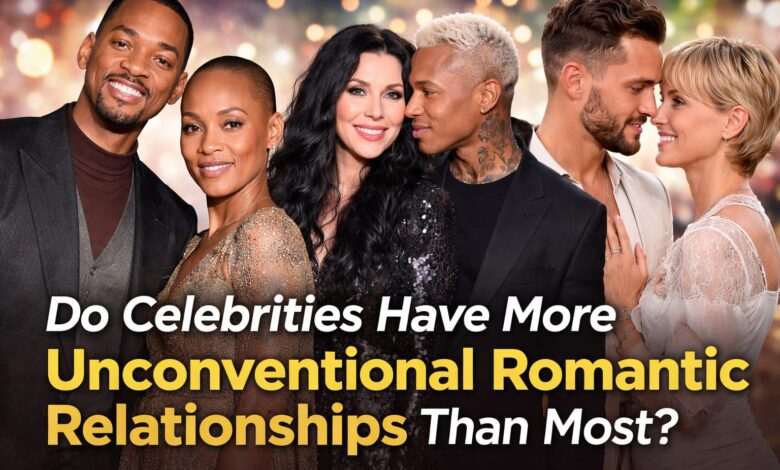
Tabloid headlines announce another famous couple has opened their marriage. A pop star reveals she is dating someone 25 years her senior. An actor discusses his polyamorous household on a late-night talk show.
Table of Contents
These stories appear so frequently that a casual observer might conclude fame itself produces unusual romantic arrangements. The assumption deserves examination. Famous people do not necessarily want different things from their relationships. They simply cannot hide what they want.
The average person who pursues an unconventional partnership does so without press coverage. No photographer captures the moment two partners invite a third into their arrangement. No interviewer asks pointed questions about age differences at dinner parties.
Privacy allows millions of ordinary people to structure their romantic lives according to their own preferences, entirely unobserved. Celebrities lack this cover. Their relationships become documented events, which distorts public perception of how common these arrangements actually are.

Private Lives, Public Scrutiny
Celebrity couples face a particular tension. Their romantic choices become public record, analyzed and debated by audiences who have no stake in the outcome. This visibility creates an illusion that famous people pursue more unusual arrangements than everyone else. The reality is harder to measure.
A 2025 survey found 61% of Americans are open to non-monogamous relationships, with 7% currently in one. It’s not as if anyone openly engages in sugar dating or polyamory without facing some level of social commentary.
Age gaps between partners draw attention when cameras are present. Cher and Alexander Edwards, separated by 40 years, have dated publicly for two years. George and Amal Clooney have a 17-year difference. These pairings exist at every income level, though they become noteworthy only when the people involved are recognizable.
Open Marriages and What Gets Reported
Will Smith and Jada Pinkett Smith provide an instructive case. The couple separated in 2016 but remains legally married. As of January 2025, sources described them as “still together” while living in separate homes.
Will told Vanity Fair that “marriage for us can’t be a prison.” This statement received extensive coverage and sparked debates about commitment, fidelity, and modern partnerships.
Similar arrangements exist in every suburb and city block. Couples separate without divorcing for financial, religious, or practical reasons all the time. They maintain households that would confuse outside observers. The Smiths differ only because their choices are tracked, quoted, and interpreted by strangers with strong opinions.
Nico Tortorella has spoken openly about polyamory for years. Tortorella and partner Bethany C. Meyers married in 2018. They welcomed a daughter in March 2023 and a son in October 2024. Their family structure receives attention because Tortorella discusses it in interviews. Meanwhile, an estimated 4 to 5% of the US population practices polyamory, according to available research. These millions of people largely go unnoticed.
Age Gaps and the Attention They Receive
Celebrity couples with notable age differences become subjects of public fascination. The pairing of a younger partner with an older, wealthy, or powerful person triggers assumptions about motives. Comments sections fill with speculation about gold-digging, midlife crises, and parental issues. None of this analysis is applied to the neighbor down the street whose wife is 20 years younger.
The frequency of age-gap relationships among famous people does not appear higher than in the general population. What differs is documentation. A celebrity photographed at dinner with a much younger partner generates content. The same couple without name recognition generates nothing.
Generational Attitudes and Openness
68% of Gen Z respondents said they would consider non-monogamous relationships in recent surveys. Younger generations seem more willing to discuss and experiment with arrangements that older cohorts kept private. This openness appears among both famous and ordinary young people.
Celebrities who came of age in this environment may feel less pressure to maintain traditional appearances. They discuss their arrangements because the cultural climate has become more accepting. Their visibility then contributes to further normalization, creating a feedback loop that makes unconventional relationships appear more common in famous circles than elsewhere.
What Fame Actually Changes
Celebrity does alter romantic possibilities in concrete ways. Wealth removes certain constraints. A person with substantial resources can maintain multiple households, travel frequently between partners, or support a non-working spouse without the financial pressures that affect most couples.
Fame also introduces complications. Affairs become front-page stories. Breakups require statements from publicists. Dating pools narrow to people who are comfortable with constant observation.
These conditions may encourage some famous people toward unconventional arrangements. If traditional marriage feels like a performance staged for public consumption, alternatives become appealing. If privacy is already impossible, openness loses some of its cost.
The Visibility Bias
The central problem with assessing celebrity relationships is selection bias. Unconventional arrangements become stories. Conventional ones do not. A famous actor who has been faithfully married for 30 years generates little coverage beyond anniversary features. An actor with an open marriage generates endless commentary.
This imbalance creates a skewed picture. It appears that celebrities pursue unusual relationships at higher rates because those relationships are the ones we hear about. The boring marriages fade into background noise while the polyamorous households and significant age gaps capture headlines.
Ordinary Complexity
Romantic relationships have always involved messiness, negotiation, and departure from stated norms. People have always cheated, separated without divorcing, maintained unconventional arrangements, and partnered across generational lines. The difference now is visibility. Celebrities cannot hide, and their visible choices get mistaken for exceptional choices.
The question is not really about celebrities at all. It is about what happens when private arrangements become public knowledge. Most people would prefer their romantic decisions remain their own business. Famous people do not have that option, so their business becomes everyone’s entertainment.