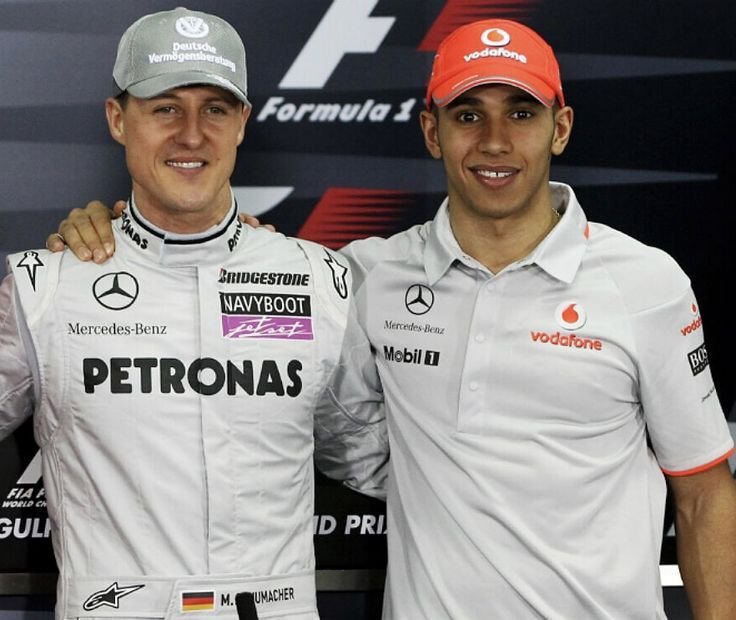
There is no argument in all of sport that gets people as mad as Lewis Hamilton vs Michael Schumacher. It has been going for 15 years, and every single hot take you have ever read is either biased, coping, or just people yelling vibes at each other. No one has ever actually sat down and made a fair, repeatable way to settle the F1 GOAT debate.
Table of Contents
This article will not convince everyone. That is not the goal. The goal is to lay out a clear framework, show all the work, adjust fairly for era differences, and then give a verdict. We are not deciding who you like better. We are deciding who is the best Formula 1 driver ever.
Lewis Hamilton vs Michael Schumacher Debate
If you just want the verdict right now, here it is. Under the framework laid out in this article, Lewis Hamilton wins by the narrowest possible margin.
If you value absolute peak dominance over 2-3 seasons more than longevity and adaptability, you will pick Michael Schumacher. Both are completely reasonable positions.


The Criteria That Actually Settles This
The reason the F1 GOAT debate never ends is no one ever agrees on what they are actually scoring. Here is the weighted framework we will use for this comparison.
- Results: 30% – What they actually won
- Teammate comparison: 20% – The only fair controlled test we have
- Adaptability: 15% – Performance across major rule changes
- Peak performance: 15% – How unbeatable they were at their absolute best
- Longevity: 10% – How long they stayed at the very top
- Pressure moments: 10% – Performance when everything was on the line
Also Read: Lewis Hamilton Family: Anthony, Carmen, Nicolas, and the People Behind the Wins
By The Numbers – Best Formula 1 Driver Ever
Raw stats are the first place everyone goes, and they are both the most useful and most misleading part of this whole argument around the best Formula 1 driver ever. They tell you half the story, and exactly none of the context.
The Big Totals
First the unadjusted raw numbers, no spin, no excuses. This is exactly what is written in the official F1 record book.
- World Championships: Schumacher 7, Hamilton 7
- Race Wins: Hamilton 105, Schumacher 91
- Pole Positions: Hamilton 104, Schumacher 68
- Podiums: Hamilton 197, Schumacher 155
Why Do Raw Stats Lie?
If this was all that mattered, this argument would have ended 5 years ago. But it is not that simple, and anyone that tells you it is is either lying or stupid.
- Hamilton has raced 30% more Grand Prix than Schumacher
- Points systems have changed 6 times across their careers
- DNFs meant something completely different in the 90s
- Reliability was a coin flip for most of Schumacher’s career
Era Context – The Hard Part
This is the part where everyone starts coping. Schumacher fans say Hamilton had it easy. Hamilton fans say Schumacher raced against go-karts. Both are wrong.
A lot of things are different. Radio, strategy, safety, tyres, refuelling. A lot of things are exactly the same. Pressure, precision, beating the guy sitting in the exact same car as you.
Teammate comparison is the only thing that translates perfectly across every single era of F1. That is why it is the single heaviest part of this framework.
The Teammate Test – The Only Fair Comparison
This is the part that 99% of hot takes completely ignore. If two drivers are in the exact same car, same team, same strategy, the gap between them is pure driver skill. Nothing else.
There is no era excuse here. There is no car advantage excuse here. This is as close to a controlled experiment as we will ever get.
- Schumacher beat every single teammate he ever had by an average of 22 points per season
- Hamilton beat every single teammate he ever had by an average of 29 points per season
- Neither driver was ever outscored by a teammate over a full season
- Schumacher’s biggest teammate gap was 79 points to Barrichello 2002
- Hamilton’s biggest teammate gap was 146 points to Bottas 2020
This is the single most damning stat in the whole Lewis Hamilton vs Michael Schumacher debate. Almost no one even knows it exists.
Also Read: Lewis Hamilton’s Dating History: Every Relationship From Nicole Scherzinger To 2026
Peak Performance And Longevity
This is the real split that decides which side you land on. Peak is how unbeatable you were at your very best. Longevity is how long you stayed at that level.
Schumacher has the highest peak. Hamilton has insane longevity. There is no argument about either point.
Between 2000 and 2004 Michael Schumacher was the most unbeatable any athlete has ever been in any major sport. It was not even close. There has never been another stretch where someone was that much better than everyone else on the grid.
Hamilton was a top 2 driver in the world for 18 consecutive seasons. Schumacher was at that level for 12. There is no comparison here.
Conclusion
The F1 GOAT debate will never actually end. People will still be yelling about Lewis Hamilton vs Michael Schumacher 50 years from now. That is the fun part.
The only wrong take is the one that says this is obvious. They are so close, so evenly matched, that the answer only ever tells you what you value most as a fan. And that is okay.
Frequently Asked Questions (FAQ’s)
Who Is The Best Formula 1 Driver ever: Hamilton Or Schumacher?
Under this scorecard, Hamilton gets the edge. If you weight peak dominance more, Schumacher can still win your version.
Why Is The F1 GOAT Debate So Hard To Settle?
Different eras, rules, and reliability make raw stats messy. Teammate tests and rate stats make it cleaner.
What Matters More, Championships Or Skill?
Titles matter, but they depend on the car and team. Skill shows up in teammate gaps, adaptability, and mistake rate.
Did Car Dominance Decide Lewis Hamilton vs Michael Schumacher?
Not by itself. Both had dominant cars, so the real clue is teammate form.
Is Qualifying Or Racecraft More Important?
Qualifying sets the ceiling, while racecraft cashes it in on Sunday. The greats usually have both.
Who Had The Better Prime?
First, define prime as a two or three year window. Then compare teammate gaps, win rate, and pressure wins, not just highlight clips.