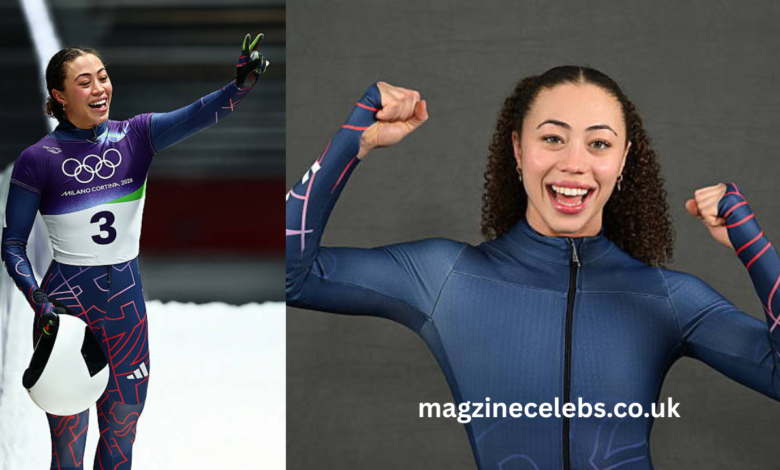
The image of a skeleton athlete sprinting across ice is a far cry from a circus performer swinging from a trapeze. Yet, for Tabitha “Tabby” Stoecker, the path to Olympic glory in Milano Cortina 2026 was paved not just on the ice, but in the air.
Table of Contents
In a sport often dominated by nations with access to multiple ice tracks, Great Britain has carved out an unlikely legacy of dominance. Stoecker is the latest heir to this throne. Her journey from a casual Instagram scroll to standing atop the Olympic podium alongside Matt Weston is one of the most compelling narratives in modern winter sports.
While many news outlets have covered the headline result, few have explored the mechanics of her rapid ascent, the unique “concrete training” constraints she overcame, or the specific data behind her victory. This guide covers the complete story of Tabitha Stoecker’s historic 2026 performance.
Tabitha Stoecker: Quick Facts
| Category | Detail |
| Full Name | Tabitha Stoecker |
| Born | Nov 24, 2000 (Highgate, London) |
| Height | 5 ft 7 in (170 cm) |
| Club | British Skeleton |
| Education | National Centre for Circus Arts (Background) |
| Olympic Partner | Matt Weston |
The Early Years: Acrobatics and Adrenaline
Before she ever considered hurtling headfirst down an ice chute at 90mph, Stoecker was mastering the art of control in a very different environment. Born in Highgate, London, she displayed natural athleticism early on, becoming a British Schools Gymnastics Champion.

However, her sporting education took a unique turn at age 11. After attending an open day at the National Centre for Circus Arts in London, she fell in love with performance. For the next six years, Stoecker’s life wasn’t about split times and aerodynamics; it was about the flying trapeze, clowning, and juggling.
This background provided a foundation that most traditional athletes lack. The spatial awareness required to catch a trapeze bar mid-air translates surprisingly well to the high-pressure environment of the skeleton. Both require:
- Body Awareness: Knowing exactly where your limbs are without looking.
- Fearlessness: The ability to suppress the natural instinct to panic when moving at speed.
- Precision: Small adjustments that yield massive consequences.
The Instagram Ad That Changed Everything
The story of how Stoecker entered the world of skeleton is a testament to the power of modern talent identification. She didn’t grow up dreaming of the Winter Olympics. She didn’t even know what the skeleton was.
In 2019, while studying for her A-levels, Stoecker stumbled upon an advertisement on Instagram for “Discover Your Gold,” a talent identification campaign run by UK Sport and the British Bobsleigh and Skeleton Association (BBSA). The campaign was looking for athletes with explosive power and a specific physiological profile.
Stoecker applied on a whim. Her raw power data and background in gymnastics flagged her as a high-potential candidate. She was invited to trials, where she learned to sprint, lift, and eventually slide. The transition was rapid, proving that her “circus skills” were more transferrable than anyone could have predicted.
A Meteoric Rise: From Novice to Champion
Stoecker’s progression through the ranks of international skeleton was nothing short of vertical. Most athletes spend years on the lower circuits honing their craft. Stoecker bypassed the learning curve.
The Breakthrough at La Plagne
After making her international debut in the Europa Cup in 2021 and securing a Junior European Championship title, she announced herself to the senior circuit in December 2023.
In just her second-ever World Cup start, Stoecker won gold in La Plagne, France. It was a watershed moment, the first time a British female slider had won a World Cup race since two-time Olympic champion Lizzy Yarnold in 2015. This victory signaled that Stoecker wasn’t just a participant; she was a contender.
Career Progression Timeline
| Year | Milestone | Result |
| 2019 | Talent ID | Selected via “Discover Your Gold” campaign |
| 2021 | International Debut | 7th place in Europa Cup |
| 2022 | Junior Worlds | Silver Medal |
| 2023 | Junior European Champs | Gold Medal |
| 2023 | World Cup (La Plagne) | Gold (First Senior Win) |
| 2024 | World Championships | Mixed Team Silver |
World Championship Heartbreak and Resilience
Leading up to the 2026 Games, Stoecker and her teammate Matt Weston established themselves as a formidable duo in the Mixed Team event. However, gold proved elusive on the world stage.
In both the 2024 World Championships in Winterberg and the 2025 Championships in Lake Placid, the pair secured silver medals. While second place is an immense achievement, for elite athletes, it fuels a specific kind of hunger. They were consistent, they were fast, but they were narrowly missing the top step of the podium.
These near-misses set the stage for Milano Cortina. The narrative wasn’t just about winning; it was about upgrading the silver to gold when it mattered most.
Milano Cortina 2026: The Historic Gold
The 2026 Winter Olympics marked the debut of the Mixed Team Skeleton event. In this format, one male and one female athlete from each nation compete, with their aggregate times determining the winner. It requires two perfect runs; a mistake by one partner cannot always be fixed by the other.
The Women’s Individual Event
Days before the team event, Stoecker competed in the individual women’s skeleton. She finished 5th overall. While a top-five Olympic finish is incredible for a debutant, it wasn’t the metalware she had targeted. This result likely alleviated some pressure, allowing her to refocus entirely on the team event.
The Mixed Team Final
On Sunday, February 15, 2026, history was made. Stoecker and Weston faced off against formidable German and Italian teams.
- The Margin: The British duo finished with a combined time of 1:59.36.
- The Rivalry: They beat the German pair (Susanne Kreher and Axel Jungk) by just 0.17 seconds.
- The Context: Matt Weston had already won individual gold days prior, but for Stoecker, this was the validation of her six-year journey.
The victory was Great Britain’s first-ever Olympic gold in the mixed team skeleton event.
Training on Concrete: The British Anomaly
To fully appreciate Stoecker’s achievement, one must understand the “British Anomaly.” Unlike their main rivals in Germany (who have four ice tracks) or the USA and Canada, Great Britain has zero ice tracks.
Stoecker trains primarily at the University of Bath on a dry “push track.” This is a concrete facility on rails that simulates the start phase of the race. British athletes become masters of the sprint start because it is the only part of the race they can practice domestically.
To win gold against nations that can slide on ice every day of the winter is a statistical improbability. It highlights the efficiency of the British coaching program and the raw adaptability of athletes like Stoecker.
The “Tabby Effect”: Inspiring the Next Generation
Olympic medals are heavy, but their true weight is measured in legacy. The impact of Stoecker and Weston’s success was immediate.
Following their gold medal win, the BBSA reported a massive surge in interest for their talent identification programs. Reports indicate that over 4,000 people signed up to try the sport in the days following the event, with 1,000 of those coming directly after the mixed team victory.
Stoecker’s story—”I saw an ad on Instagram”—resonates because it is accessible. It suggests that the next Olympic champion could be anyone currently scrolling through their phone, unaware of their potential.
2026 Net Worth
While athletes in niche winter sports rarely command the multimillion-dollar contracts of footballers, Olympic success brings financial rewards through funding and sponsorship.
Net Worth Analysis
As of 2026, Tabitha Stoecker’s exact net worth is not publicly disclosed. However, we can estimate her financial standing based on her status as an elite UK athlete:
- Funding: As a Gold Medalist, Stoecker is eligible for the highest tier of UK Sport’s World Class Programme funding (Athlete Performance Award), which can provide up to £28,000 tax-free annually for living costs, plus extensive coaching and travel support.
- Sponsorship: Olympic Gold significantly raises an athlete’s profile. Post-2026, she is likely to secure partnerships with apparel brands, equipment manufacturers, and lifestyle sponsors.
- Prize Money: IBSF World Cup race wins and World Championship podiums come with modest prize purses, usually in the thousands rather than tens of thousands.
Frequently Asked Questions
How fast did Tabitha Stoecker go during her Olympic run?
Skeleton athletes typically reach speeds of up to 135 km/h (84 mph) depending on the track. At Milano Cortina, speeds were consistently in the 130 km/h range.
What is the Mixed Team Skeleton event?
It is a relay-style event where one male and one female athlete from the same country take one run each. Their times are added together, and the lowest aggregate time wins.
Did Tabitha Stoecker win an individual medal in 2026?
No, she finished 5th in the Women’s Individual Skeleton event. Her gold medal came in the Mixed Team event.
How does Stoecker train without an ice track in the UK?
She trains at the University of Bath using a “push track”—a facility on rails that simulates the sprint start. She travels to Europe and North America during the winter season to train on ice.
What is Tabitha Stoecker’s background before skeleton?
She was a British Schools Gymnastics Champion and trained in circus arts (trapeze, juggling, acrobatics) at the National Centre for Circus Arts.
How old was Stoecker when she won Olympic Gold?
Born in November 2000, she was 25 years old during the 2026 Winter Olympics.
Who is Matt Weston?
Matt Weston is Stoecker’s teammate. He won the Men’s Individual Gold at the 2026 Olympics and partnered with Stoecker to win the Mixed Team Gold.
8. What was the margin of victory in the 2026 Mixed Team event?
Team GB beat the German team by 0.17 seconds.
How can I get into a skeleton like Tabitha?
The BBSA runs talent identification campaigns similar to “Discover Your Gold.” Keep an eye on the British Bobsleigh and Skeleton Association website for try-out dates.
What sled does Tabitha Stoecker use?
Elite British athletes use highly customized sleds developed in partnership with the Bromley brothers and British Skeleton’s innovation partners, focusing on aerodynamics and steel runner technology.
Conclusion
Tabitha Stoecker’s journey to the top of the Olympic podium is a masterclass in seizing opportunity. She transformed a background in circus arts into a career in one of the world’s most extreme sports, all starting from a simple social media advertisement.
Her 2026 victory with Matt Weston not only cemented Great Britain’s status as a skeleton superpower but also validated the effectiveness of the nation’s talent identification programs. By overcoming the disadvantage of having no home ice to train on, Stoecker has proven that resilience and raw talent, when nurtured correctly, can defy the odds.
As the dust settles on Milano Cortina, Stoecker’s legacy is already taking shape not just in the gold medal hanging around her neck, but in the thousands of young athletes now signing up to slide, hoping to follow in her tracks.